
 By Admin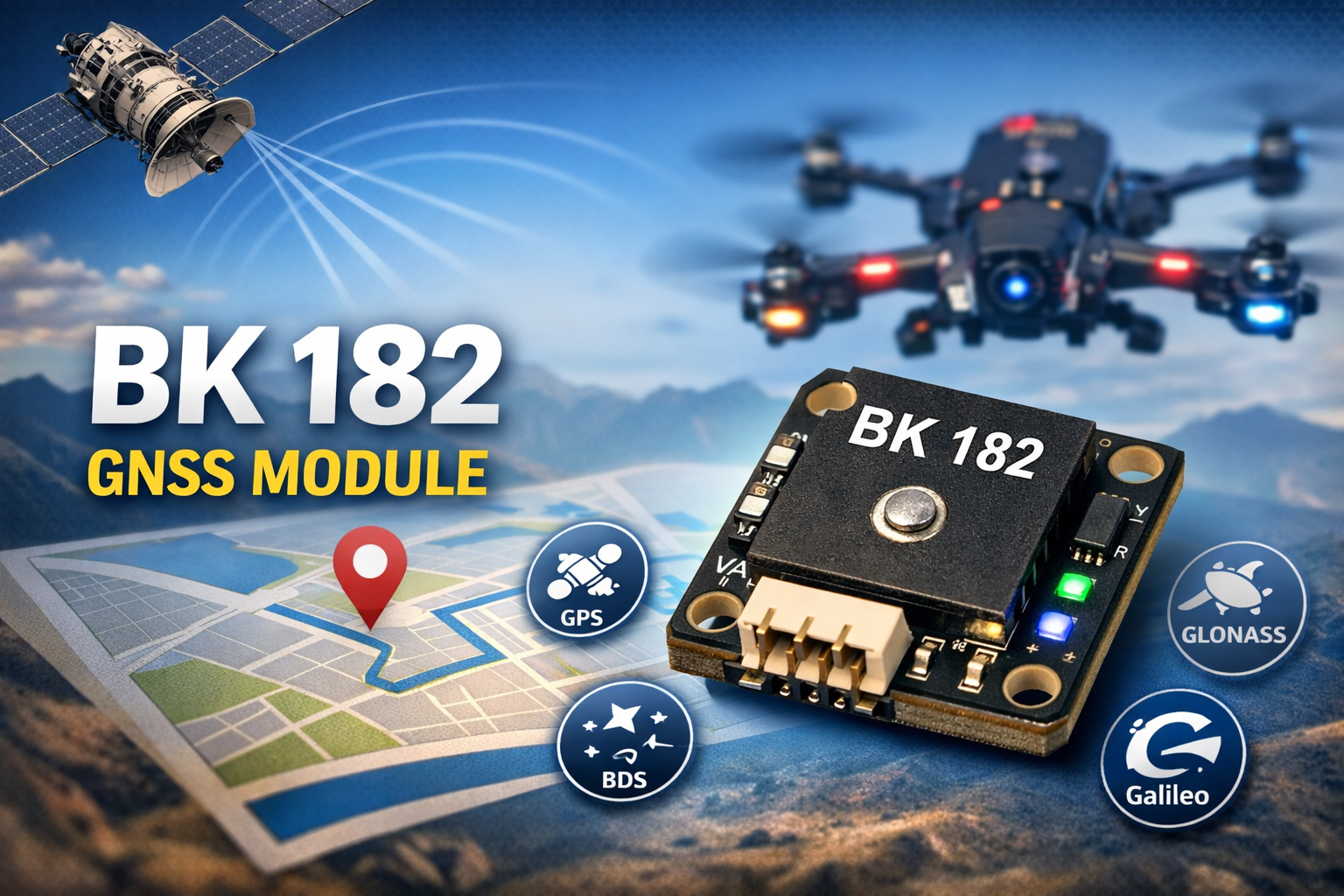
If you’ve been searching for BK 182, you’re probably looking at the Beitian BK-182, a compact GNSS module that shows up a lot in FPV drone and UAV builds. And honestly… it makes sense. It’s small, light, and built for people who want reliable positioning without adding too much bulk to a flying setup.
What makes it interesting is that it’s not just a basic GPS puck. The BK-182 is built around the M9140-KB chip, supports GPS, GLONASS, BDS, and Galileo, and outputs data through NMEA and UBX protocols. So yes, it’s tiny — but it’s doing real work in the background, especially for flight control and navigation tasks.
BK 182 at a glance
Before getting into the practical side, here’s the quick version.
| Feature | BK-182 Details |
|---|---|
| Product type | GNSS module |
| Brand / Model | Beitian BK-182 |
| Chip | M9140-KB / u-blox M9 platform |
| Supported systems | GPS, GLONASS, BDS, Galileo |
| Accuracy | 1.5 m CEP |
| Update rate | 0.25 Hz to 25 Hz |
| Protocols | NMEA, UBX |
| Voltage | 3.6 V to 5.5 V |
| Current | 25 mA at 5.0 V |
| Size | 18 × 18 × 8.1 mm |
| Weight | 8.5 g |
These specs come from Beitian’s official BK-182 page, with the M9 platform details supported by u-blox documentation and retailer listings for BK-122/182 modules.
Why people use BK 182 in drones
The real value of a module like BK 182 shows up once you connect it to an FPV drone or UAV. It helps the flight controller know where the aircraft is, how fast it’s moving, and sometimes whether it can safely trigger recovery behavior. That matters more than people think… especially when signal gets sketchy.
Oscar Liang’s recent FPV roundup explains why GPS modules have become a big deal again: newer Betaflight features like GPS Rescue and Position Hold, plus Return to Home in iNav, make GNSS modules much more useful for everyday pilots. In other words, this isn’t just a nerdy extra part anymore. For many builds, it’s becoming standard.
And that’s where the BK-182 fits in nicely.
- It supports multiple satellite constellations, which can improve positioning reliability.
- It offers up to 25 Hz updates, which is useful for fast-moving drone applications.
- It uses TTL level wiring and common protocols, so integration is pretty straightforward.
- It stays compact at 18 mm square and only 8.5 g, which is helpful on lighter builds.
What stands out about the BK 182
One thing I like about the BK 182, at least on paper, is that it feels balanced. Not oversized. Not absurdly stripped down. Just a sensible middle ground. Beitian lists 1.5 m CEP horizontal accuracy, a default 1 Hz update rate that can be pushed up to 25 Hz, and support for flash memory, so configuration changes can be saved instead of disappearing after power loss. That’s a practical little feature people often overlook.
There are also a few details that matter if you actually build things. The official page lists 3.6 V to 5.5 V input, 25 mA current draw at 5 V, a 4-pin socket, and built-in LEDs for TX activity and GPS fix behavior. None of that is flashy, sure. But it helps during setup and troubleshooting, and that can save a lot of time.
Another plus is the wider chip family behind it. u-blox says the UBX-M9140 platform is designed for meter-level accuracy, supports concurrent reception of four GNSS systems, and is suitable for applications including UAVs. So the BK-182 isn’t just some random anonymous module code floating around online — it’s tied to a real GNSS platform with clear use cases.
Is BK 182 a good choice?
For many pilots, yes… especially if the goal is a compact GPS module for rescue and general positioning. It looks like a smart fit for users who want something lightweight, reasonably capable, and easy to wire into a flight controller. The usual V/G/T/R connection layout shown on BK-122/182 product pages also keeps installation pretty simple.
But, like with most GPS hardware, raw specs don’t tell the whole story. Real-world lock times, antenna placement, noise from nearby electronics, and open-sky conditions still matter a lot. Oscar Liang’s testing notes make that very clear: even good modules behave differently depending on environment, and pilots are generally advised to wait for a solid satellite lock before takeoff for reliable rescue features.
Final thoughts
So, what is BK 182 really? In the drone world, it’s best understood as a small Beitian GNSS module made for FPV and UAV navigation. It supports modern satellite systems, runs on the u-blox M9 platform, stays light, and offers the kind of specs that make sense for rescue-focused and navigation-aware builds. Not hype. Just a useful little component that does an important job.